What Makes a Competitive BTZ Score? Benchmarks
Break down each BTZ scoring category with specific benchmarks and 3 calculated examples showing what separates competitive scores from average ones.
A competitive BTZ score doesn't happen by accident. It's built category by category, and every point gap has a concrete explanation. This breakdown covers what each scoring area actually rewards, what the numbers look like at different performance levels, and how to calculate where you currently stand before your board.
Run your current numbers through the BTZ score calculator while you read, the benchmarks below mean more when you can see your own totals in real time.
The Scoring System at a Glance
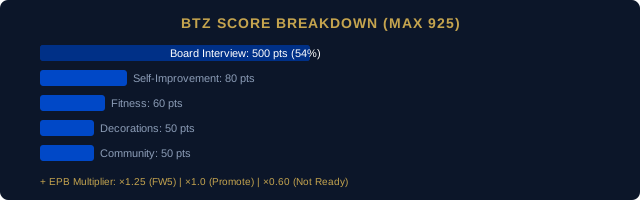
The BTZ formula under AFI 36-2502 has six components. Three are scored before the board, one happens at the board, and one acts as a global multiplier:
| Component | Max Points | How It's Calculated |
|---|---|---|
| Board score | 500 | Avg of 5 categories (0–10) × 50 |
| Self-improvement | 80 | Score (0–10) × 8 |
| Air Force Fitness Assessment | 60 | FA score ÷ 100 × 60 |
| Decorations & awards | 50 | Count × 5, capped at 10 decorations |
| Community involvement | 50 | Score (0–10) × 5 |
| EPB multiplier | ×0.60 to ×1.25 | Applied to the full base total |
The base maximum (before EPB multiplier) is 740 points. A Firewall 5 EPB stretches that to 925. The four competitive tiers are:
- ›Highly Competitive: 80%+ of 925 = 740+ points
- ›Competitive: 65–79% = 600–739 points
- ›Moderate: 50–64% = 462–599 points
- ›Needs Improvement: Below 50% = under 462 points
Now let's go through each category and show what the numbers actually look like.
Board Score: The Biggest Lever (Up to 500 Points)
The board score dominates the formula because it can account for 500 of your 740 base points, 67% of your pre-EPB total. The five board categories typically include:
- 1.Job knowledge
- 2.Military bearing
- 3.Dress and appearance
- 4.Communication skills
- 5.Leadership potential or self-assessment (varies by board)
Each is scored 0–10 by the panel. The five scores get averaged, then multiplied by 50.
What different averages look like:
| Average Score | Points Earned | Notes |
|---|---|---|
| 9.5 / 10 | 475 | Nearly perfect, rare, reserved for exceptional performers |
| 8.5 / 10 | 425 | Strong board, solid job knowledge, sharp uniform, confident answers |
| 7.5 / 10 | 375 | Average board, minor stumbles, compliant but not impressive |
| 6.5 / 10 | 325 | Below average, hesitant answers, uniform issues, unclear communication |
| 5.0 / 10 | 250 | Poor performance, missing job knowledge, bearing issues |
The difference between an 8.5 and a 7.0 average is 75 points, before the EPB multiplier amplifies it. After a Firewall 5 multiplier, that 75-point gap becomes 93 points.
A 7.0 board score with a Firewall 5 EPB can still beat a 9.0 board score with a Promote EPB, because the EPB acts on the entire total, not just one category. This is why the EPB conversation with your supervisor matters so much, read how your EPB rating shapes your BTZ score for the full breakdown.
Self-Improvement: Up to 80 Points
Self-improvement is scored 0–10, then multiplied by 8. The score reflects education, professional development, and off-duty training efforts.
What earns points:
- ›CCAF enrollment or completion (major factor)
- ›CDCs completion ahead of schedule
- ›Off-duty college coursework
- ›PME completion (Airman Leadership School counts)
- ›Language training, technical certifications
Score benchmarks:
| Score | Points | Profile |
|---|---|---|
| 10 | 80 | CCAF degree in progress, ALS complete, additional college coursework |
| 8 | 64 | CCAF enrolled, at least one course completed |
| 6 | 48 | CDCs current, no additional education |
| 4 | 32 | Minimal self-improvement beyond required training |
The jump from a 6 to an 8 adds 16 points, equivalent to 3.2 more board score points or roughly a half-point average improvement on the panel interview. Enrolling in CCAF is probably the single highest-ROI action you can take 3–6 months before your board.
Air Force Fitness Assessment: Up to 60 Points
The FA contribution is straightforward: divide your score by 100, then multiply by 60.
| FA Score | BTZ Points |
|---|---|
| 100 | 60.0 |
| 95 | 57.0 |
| 90 | 54.0 |
| 85 | 51.0 |
| 75 | 45.0 |
| 70 | 42.0 |
The gap between a 90 and a 75 FA score is 9 BTZ points. That's meaningful in a close race, but fitness is rarely where you close the biggest gap, unless your board scores and EPB are already strong and you're trying to push from Competitive to Highly Competitive.
One practical note: if you have multiple FA scores on record, confirm with your unit's BTZ monitor which one is used, typically it's the most recent score within the eligibility period.
Decorations & Awards: Up to 50 Points
Each decoration earns 5 points, capped at 10 decorations (50 points max). Common decorations A1Cs and SrAs earn that count toward this total:
- ›Air Force Achievement Medal (AFAM)
- ›Army Achievement Medal (AAM) (if joint assignment)
- ›Air Force Commendation Medal (AFCM)
- ›Meritorious Service Medal (MSM)
- ›Unit awards (Air Force Outstanding Unit Award counts)
Score scenarios:
| Decorations | Points |
|---|---|
| 1 | 5 |
| 3 | 15 |
| 5 | 25 |
| 10 | 50 (max) |
Most A1Cs approaching BTZ have 1–3 decorations. If you've done a joint tour, deployed, or received recognition for a specific achievement, you may have more. Each missing decoration that you legitimately earned is a free 5 points, verify your records in MilPDS and flag anything that isn't reflected.
Community Involvement: Up to 50 Points
Community involvement is scored 0–10 then multiplied by 5. This category rewards documented participation in base and off-base volunteer activities, Key Spouse programs, Airman's Attic, chapel programs, and similar efforts.
| Score | Points | What It Looks Like |
|---|---|---|
| 10 | 50 | Regular volunteer across multiple organizations, leadership role |
| 7 | 35 | Consistent participation in 1–2 organizations over 12+ months |
| 5 | 25 | Occasional volunteer, 3–5 events over the year |
| 3 | 15 | Minimal documented involvement |
Documentation is the operative word. Volunteer hours that aren't logged don't earn points. Keep a personal record of every event: date, organization, hours, supervisor or POC name.
Three Worked Calculation Examples
Example 1: The Strong Performer with a Promote EPB
A1C Martinez has an 8.6 board average, fitness score of 91, self-improvement score of 9 (CCAF in progress, ALS complete), 3 decorations, and community involvement score of 7. EPB: Promote (×1.0).
- ›Board: 8.6 × 50 = 430 pts
- ›Self-improvement: 9 × 8 = 72 pts
- ›Fitness: (91/100) × 60 = 54.6 pts
- ›Decorations: 3 × 5 = 15 pts
- ›Community: 7 × 5 = 35 pts
- ›Base total: 606.6 pts
- ›EPB multiplier (×1.0): 607 pts → 65.6% of 925 → Competitive
Example 2: The Moderate Performer with a Firewall 5 EPB
A1C Chen has a 7.0 board average, fitness score of 82, self-improvement score of 6 (CDCs current, no CCAF), 1 decoration, and community involvement score of 4. EPB: Firewall 5 (×1.25).
- ›Board: 7.0 × 50 = 350 pts
- ›Self-improvement: 6 × 8 = 48 pts
- ›Fitness: (82/100) × 60 = 49.2 pts
- ›Decorations: 1 × 5 = 5 pts
- ›Community: 4 × 5 = 20 pts
- ›Base total: 472.2 pts
- ›EPB multiplier (×1.25): 590 pts → 63.8% of 925 → Moderate
Example 3: The Highly Competitive Package
A1C Okonkwo has a 9.2 board average, fitness score of 98, self-improvement score of 9, 4 decorations, and community involvement score of 8. EPB: Firewall 5 (×1.25).
- ›Board: 9.2 × 50 = 460 pts
- ›Self-improvement: 9 × 8 = 72 pts
- ›Fitness: (98/100) × 60 = 58.8 pts
- ›Decorations: 4 × 5 = 20 pts
- ›Community: 8 × 5 = 40 pts
- ›Base total: 650.8 pts
- ›EPB multiplier (×1.25): 813.5 pts → 87.9% of 925 → Highly Competitive
The gap between Example 1 and Example 3 is 206 points. The board score accounts for 30 of those points, the EPB multiplier accounts for 152. This is the core insight: a good board performance with a Promote EPB loses to an average board performance with a Firewall 5, almost every time.
What "Highly Competitive" Actually Means in Practice
Clearing 80% of the 925-point maximum (740+ points) doesn't guarantee selection, it means you're in the cohort most likely to be selected. In a large unit board, the top 15% of eligible Airmen are selected. If 20 Airmen are eligible, 3 get picked. If all 20 are highly competitive, 17 don't get selected.
What you can control: your board score (preparation), your EPB (performance and communication with your supervisor), your fitness (training), and your self-improvement (enrollment and completion). Run your numbers with the BTZ promotion estimator and identify which category gives you the most room to improve.
For a detailed breakdown of board prep tactics, read how to prepare for your BTZ board. To understand how the large unit and small unit board processes affect competitive dynamics, see large unit vs small unit BTZ boards.
Want to know more about the scoring methodology behind this calculator? Visit the about page.
Related Tool
Calculate your Below the Zone promotion score
Written by
BTZ Calculator Team
Current and former Air Force NCOs with firsthand experience in the BTZ selection process, as candidates, supervisors, board members, and First Sergeants. All content is grounded in AFI 36-2502 and AFPC guidance. Learn more about us →