How to Prepare for Your BTZ Board: 2026 Guide
Step-by-step BTZ board prep guide: uniform standards, job knowledge, package-building 3–6 months out, and a worked score calculation example.
BTZ Board Preparation Starts Months Before the Date
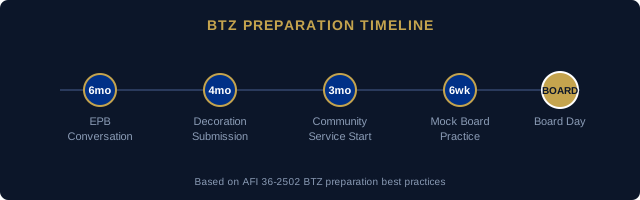
Below the Zone board preparation isn't something you start two weeks out. The Airmen who walk in confident, and walk out selected, typically started building their package 3 to 6 months before the board date. That's not hype. That's the reality of what it takes to score in the top tier against your peers.
This guide breaks down exactly what to do, when to do it, and what the numbers look like when you get it right. If you want to see how the scoring formula works before diving into prep, run your numbers through the BTZ promotion calculator first.
Understand the Scoring Formula Before You Prep
You can't prepare for something you don't understand. The BTZ scoring system under AFI 36-2502 breaks into six weighted categories:
- ›Board score, Up to 500 points (5 categories scored 0–10, averaged, then × 50)
- ›Self-improvement, Up to 80 points (score × 8)
- ›Air Force Fitness Assessment, Up to 60 points (FA score ÷ 100 × 60)
- ›EPB multiplier, Firewall 5 = ×1.25, Promote = ×1.0, Not Ready = ×0.60
- ›Decorations, Up to 50 points (count × 5, capped at 10 decorations)
- ›Community involvement, Up to 50 points (score × 5)
Your base maximum before the EPB multiplier is 740 points. With a Firewall 5, you can reach 925. With a "Promote" rating, your ceiling is 740. That 185-point gap from the EPB multiplier alone can determine whether you're competitive or not.
Know where your score sits right now. Then you know exactly which areas to attack.
Phase 1: Six Months Out, Build the Foundation
Lock in your fitness score. The FA contributes up to 60 points, but more importantly, showing up to the board in obvious physical shape signals discipline. A score of 90 gives you 54 points. A 75 gives you 45. That 9-point gap is real. Train consistently, not frantically.
Start your CCAF coursework. Self-improvement under AFI 36-2502 includes CCAF credits, CDCs, off-duty education, and PME. Each point of self-improvement score × 8 adds to your total, a score of 9 gives you 72 points, versus 56 points at a 7. Enroll in at least one CCAF course if you haven't already. Even being actively enrolled shows initiative.
Talk to your supervisor about your EPB. This is the conversation most junior Airmen avoid, and it costs them. Ask directly: "What would I need to demonstrate over the next 6 months to be considered for a Firewall 5 EPB?" Your supervisor should give you honest metrics, specific projects, leadership moments, or documented results they'd need to see. If they won't give you a straight answer, escalate to your NCOIC.
Document your community involvement now. Volunteer hours, base events, Key Spouse activities, Airman's Attic, these matter. A community involvement score of 8 gives you 40 points. A 5 gives you 25. Keep a running log with dates and hours.
Phase 2: Three Months Out, Sharpen the Package
Gather your decoration citations. Each decoration counts as 5 points toward your total, up to 10 decorations (50 points max). The Air Force Achievement Medal (AFAM) and Army Achievement Medal (AAM) count. So does the Meritorious Service Medal (MSM). Make sure every decoration you've earned is reflected in your records. Missing decorations are free points you're leaving on the table.
Start board question prep. Board members will ask questions across five job knowledge areas:
- 1.Military bearing and dress/appearance
- 2.Job knowledge specific to your AFSC
- 3.Communication skills (how you present yourself under pressure)
- 4.Teamwork and leadership examples
- 5.Self-improvement and professional development
Write out 10 potential questions in each category. Record yourself answering them. Watch the recording. This is uncomfortable, and it works.
Do a uniform inspection, not a "looks good enough" check. Get your dress blues out. Check every ribbon placement against AFI 36-2903. Check the spacing between ribbons (3.2mm gap, stacked left-to-right). Check that your name tag is centered 1 inch above the top of the right breast pocket. Have a senior NCO you trust do the inspection. Don't guess.
Phase 3: Six Weeks Out, Pressure Test Everything
Run mock boards. Ask your flight chief or NCOIC to conduct a formal mock board with at least two other NCOs. Dress in your uniform. Stand at parade rest. Answer questions as if the real board is happening. Get brutal feedback.
Know your EPR/EPB cold. You will be asked to explain bullet points from your performance reports. If a board member asks about a project you led 18 months ago and you stammer, that hurts your communication skills score. Review every performance document and prepare a 90-second narrative for each major accomplishment.
Check your fitness status. If your last FA was more than 5 months ago, see if you can schedule a newer one before the board date. A higher, more recent score reflects current fitness, boards notice.
A Worked Calculation Example
Let's say A1C Carter is going to her BTZ board. Here's her situation:
- ›Board scores: 8.5, 8.0, 8.5, 9.0, 8.0 → average = 8.4 → × 50 = 420 points
- ›Self-improvement score: 8 → × 8 = 64 points
- ›Fitness score: 88.0 → ÷ 100 × 60 = 52.8 points
- ›Decorations: 3 → × 5 = 15 points
- ›Community involvement: 7 → × 5 = 35 points
Base total before EPB: 420 + 64 + 52.8 + 15 + 35 = 586.8 points
With a Promote EPB (×1.0): 586.8 points
With a Firewall 5 EPB (×1.25): 733.5 points
That 146-point swing from the EPB multiplier alone moves her from "Competitive" territory (65–79%) to "Highly Competitive" (80%+) against the 925-point maximum. This is why the EPB conversation at the 6-month mark matters more than almost anything else.
Run your own scenario with the BTZ score estimator to see exactly where you stand.
What Board Members Are Actually Looking For
Talk to anyone who's sat on a large unit BTZ board and they'll tell you the same thing: they're evaluating whether they'd trust this Airman with more responsibility. That's the job knowledge question underneath all the other questions.
Military bearing isn't just standing straight. It's how you enter the room (knock, ask permission, close the door behind you), how you transition between parade rest and attention, how you look at the president of the board when you speak versus when you listen, and whether your uniform looks like you spent 30 minutes on it or 3 hours.
Communication skills show up immediately. Board members watch how long it takes you to start answering a question. Pausing to think is fine, 3 seconds is professional, 8 seconds suggests you weren't prepared. Answer in complete sentences with a structure: direct answer, supporting example, what you learned or what the result was.
Job knowledge questions vary by AFSC, but common board questions include: Explain the mission of your unit. What is your commander's priority this quarter? Walk me through what you do when you receive a tasker. Describe a time you identified a problem and fixed it without being told to.
The Package That Gets Selected
The Airmen who earn BTZ don't just show up prepared, they show up documented. Every accomplishment that can be verified should be in your records. Every education course should be reflected. Every volunteer hour should be logged.
Three months before your board date, your supervisor should be writing bullets for your EPB that reflect specific, measurable results. If they're not, have the conversation. You're not being pushy, you're being professional.
For more on what separates competitive BTZ scores from average ones, read what makes a competitive BTZ score. And if you're wondering how the large unit board process compares to the small unit process, large unit vs small unit BTZ boards breaks down the key differences.
To learn more about how thebtzcalculator.com was built and the sources behind the formula, visit the about page.
One Final Point
The preparation you do for a BTZ board makes you a better Airman whether you're selected or not. The uniform discipline, the fitness, the education, the communication practice, all of it transfers. Most Airmen who aren't selected for BTZ go on to promote to SrA on their normal timeline with a significantly stronger package and a much clearer understanding of the promotion system.
Start now. Six months goes faster than you think.
Related Tool
Calculate your Below the Zone promotion score
Written by
BTZ Calculator Team
Current and former Air Force NCOs with firsthand experience in the BTZ selection process, as candidates, supervisors, board members, and First Sergeants. All content is grounded in AFI 36-2502 and AFPC guidance. Learn more about us →