BTZ vs Regular SrA Promotion: Key Differences
Compare BTZ early promotion to the standard A1C-to-SrA path. Covers TIS windows, board vs WAPS, the 15% quota rule, and why trying matters regardless.
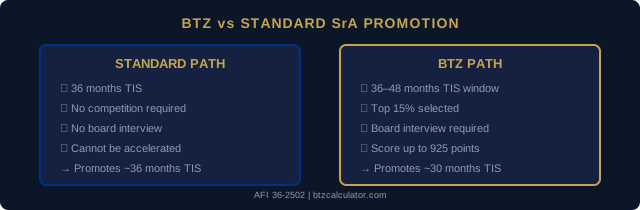
Two Paths to Senior Airman, Only One Lets You Get There Early
The standard path from Airman First Class (A1C, E-3) to Senior Airman (SrA, E-4) is fixed by time. Serve long enough, stay out of trouble, and the promotion happens automatically. Below the Zone changes that equation. It gives the top performers in each unit the chance to pin on SrA up to 6 months early, with a board process, a formula, and real competition.
Understanding exactly how these two promotion paths work helps you decide whether to pursue BTZ, and how hard to push if you do.
The Standard A1C to SrA Promotion
Under the Enlisted Promotion System (EPS), the standard promotion to SrA happens automatically when an Airman meets both time requirements defined in AFI 36-2502:
- ›36 months Time-in-Service (TIS), or
- ›20 months Time After Fixed Military Service date (TAFMS), whichever is later
You don't compete for this promotion. You don't go before a board. You meet the time criteria, your commander approves, and you pin on SrA. AFPC processes the promotion order.
This is sometimes called the "sanctuary" promotion. It's available to every A1C who performs satisfactorily. The only way to lose it is serious misconduct or a negative recommendation from your commander.
The limitation: there's no way to speed it up through performance. No matter how outstanding your EPB is or how many decorations you earn, you wait out the TIS clock.
Below the Zone: The Early Promotion Path
BTZ promotion allows an A1C to pin on SrA up to 6 months before they would reach the standard TIS requirement. Instead of 36 months TIS, a BTZ selectee can promote at roughly 30 months TIS.
To be eligible for BTZ consideration, an Airman must:
- ›Have at least 36 months TIS but no more than 48 months TIS at the projected promotion date
- ›Have at least 20 months TAFMS at the projected promotion date
- ›Not have a referral EPB or a UIF (Unfavorable Information File)
- ›Be recommended by their commander
The eligibility window is narrow. Miss it, either because your TIS is too short when the board meets, or because you already passed the 48-month mark, and the opportunity is gone.
The 15% Quota Rule
This is where a lot of junior Airmen misunderstand BTZ. The promotion quota for BTZ is 15% of the promotion-eligible population per unit cycle, but that 15% operates differently depending on unit size.
For large units (7 or more eligible Airmen), a formal base-level board convenes. The board scores each candidate under AFI 36-2502's formula, ranks them, and selects the top 15%. If a unit has 20 eligible Airmen, 3 get selected (20 × 0.15 = 3).
For small units (6 or fewer eligible Airmen), the unit commander may receive an allocation of 0, 1, or 2 quotas depending on the number of eligible Airmen, and the selection is made at the unit level.
In practical terms: 85% of Airmen who are eligible for BTZ do not get selected. This isn't a consolation prize process. It's a competitive selection that mirrors how the Air Force actually evaluates performance.
How the Board Process Differs from WAPS
The standard SrA promotion has no competitive component. It's purely time-based. But for E-5 through E-7 promotions, the Air Force uses the Weighted Airman Promotion System (WAPS), which includes Promotion Fitness Exam (PFE) scores, Specialty Knowledge Test (SKT) scores, EPR ratings, decorations, and time-in-grade.
BTZ uses a different formula than WAPS. There's no written test. The scoring breaks down as:
| Category | Max Points |
|---|---|
| Board score (5 areas × avg × 50) | 500 |
| Self-improvement | 80 |
| Air Force Fitness Assessment | 60 |
| EPB multiplier effect | Up to 185 extra |
| Decorations | 50 |
| Community involvement | 50 |
| Base maximum | 740 |
| Total maximum (FW5 EPB) | 925 |
The biggest structural difference from WAPS: the live board interview accounts for 500 of the 740 base points. In WAPS, you can score well without ever standing in front of a panel. BTZ demands in-person performance. How you present yourself, how you answer questions, how your uniform looks, all of it directly feeds the board score.
Use the BTZ calculator to model how changes in your board score or EPB rating shift your overall point total.
Eligibility Overlap: Who Gets Considered for Both?
Almost every Airman who is BTZ-eligible will also become SrA on their standard timeline if they don't get selected. The two paths aren't mutually exclusive, they're sequential.
An A1C at 32 months TIS might be considered for BTZ this cycle. If not selected, they'll hit the standard 36-month mark in 4 months and promote automatically. The effort invested in BTZ prep (uniform, fitness, job knowledge, package) directly improves the quality of their overall service record going into their automatic SrA promotion and beyond.
Why Pursuing BTZ Is Worth It Even Without Selection
Six months of early promotion to E-4 means:
- ›Approximately $1,800–$2,400 in additional base pay over those 6 months (based on current E-4 vs E-3 base pay difference at various years of service)
- ›Earlier eligibility for the next promotion cycle (E-5)
- ›A stronger record that follows you through every subsequent promotion board
- ›A demonstrated record of competitive performance documented in your official file
But the less obvious benefit is the preparation itself. The Airmen who go through a real BTZ board, who did the mock boards, nailed their uniform, rehearsed their job knowledge questions, consistently perform better in their unit, have stronger EPBs, and earn higher WAPS scores when they compete for SSgt.
The preparation changes you. Getting selected is the bonus.
A Side-by-Side Comparison
| Factor | Standard SrA Promotion | BTZ Promotion |
|---|---|---|
| Eligibility trigger | TIS/TAFMS milestone | Board + commander recommendation |
| Competition required | No | Yes (top 15%) |
| Board interview | No | Yes |
| Earliest promotion point | ~36 months TIS | ~30 months TIS |
| EPB impact | Affects future records | Direct multiplier on score |
| Formula-based scoring | No | Yes (up to 925 pts) |
| What happens if you miss | Promote normally | Wait for next cycle or standard path |
Making Your Decision
If you're within the BTZ eligibility window, the question isn't really "should I try?", it's "how seriously am I going to prepare?" Half-hearted preparation gets you a mediocre board score and a disappointing result. Real preparation might get you selected, and will absolutely make you a better Airman either way.
Read about how to prepare for your BTZ board to build out your 6-month timeline. For a breakdown of what scores actually look competitive, see what makes a competitive BTZ score.
To understand how this site calculates your score and what sources we used, visit the about page.
Run your current stats through the BTZ promotion point estimator and see where you actually stand. Then build a plan to close the gap.
Related Tool
Calculate your Below the Zone promotion score
Written by
BTZ Calculator Team
Current and former Air Force NCOs with firsthand experience in the BTZ selection process, as candidates, supervisors, board members, and First Sergeants. All content is grounded in AFI 36-2502 and AFPC guidance. Learn more about us →