How Your EPB Rating Shapes Your BTZ Score
Your EPB multiplier can add up to 185 points to your BTZ total. Learn what Firewall 5 means, how supervisors decide, and how to have the conversation early.
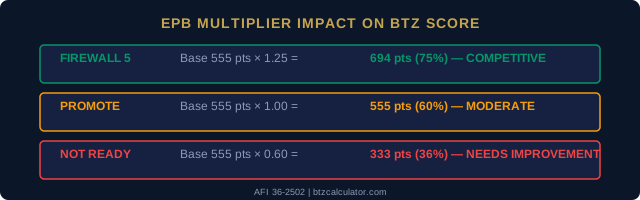
Your EPB rating is the most powerful single variable in the BTZ scoring formula, and it's also the one you have the least direct control over. A Firewall 5 multiplies your entire base score by 1.25. A Promote rating multiplies by 1.0. That difference can swing your total by up to 185 points on a 740-point base. No amount of board performance or fitness improvement closes a gap that large.
Understanding how the EPB works, what it means, how supervisors make the call, and how to put yourself in position for a Firewall 5, is as important as any other part of your BTZ preparation.
What the EPB Actually Is
The Enlisted Performance Brief (EPB) replaced the old Enlisted Performance Report (EPR) for junior enlisted Airmen at the E-1 through E-4 level. It's a supervisor-written evaluation that documents your performance, job knowledge, and potential over a rating period.
Under AFI 36-2502, there are three possible EPB ratings for BTZ purposes:
- ›Firewall 5 (FW5): The highest possible rating. Reserved for Airmen who "clearly exceed standards" across all performance areas and demonstrate the potential to perform at the next higher grade.
- ›Promote (P): The standard rating for Airmen who meet all expectations and are ready for promotion on the normal timeline.
- ›Not Ready (NR): The Airman is not recommended for promotion. This rating essentially removes you from BTZ competition, a Not Ready EPB applies a ×0.60 multiplier.
The system is intentionally restrictive at the top. Not every high-performing Airman gets a Firewall 5. Your supervisor has to justify it through specific, documented performance, not just a feeling that you're doing well.
The Math: What Each Rating Is Actually Worth
Let's put real numbers on this. Take an Airman with the following pre-EPB base score:
- ›Board score: 8.0 avg × 50 = 400 pts
- ›Self-improvement: 7 × 8 = 56 pts
- ›Fitness: (88/100) × 60 = 52.8 pts
- ›Decorations: 2 × 5 = 10 pts
- ›Community: 6 × 5 = 30 pts
- ›Base total: 548.8 pts
Now apply each multiplier:
| EPB Rating | Multiplier | Final Score | % of 925 Max | Tier |
|---|---|---|---|---|
| Firewall 5 | ×1.25 | 686 pts | 74.2% | Competitive |
| Promote | ×1.0 | 549 pts | 59.4% | Moderate |
| Not Ready | ×0.60 | 329 pts | 35.6% | Needs Improvement |
The gap between a Firewall 5 and a Promote rating for this candidate: 137 points. That's not a rounding error. It's the difference between "Competitive" and "Moderate" on the scoring scale.
For a candidate with a higher base score (say, 650 pts), the FW5 generates 812.5 pts (87.8%, Highly Competitive) versus a Promote at 650 pts (70.3%, Competitive). The gap grows to 162.5 points because the multiplier acts on a larger base.
Run your own scenario with the BTZ promotion calculator to see exactly what the multiplier does to your specific numbers.
What "Firewall 5" Actually Looks Like on the Form
The phrase "Firewall 5" comes from marking the performance rating boxes at their maximum values, pushing the performance indicator to the wall, all the way to 5.
On the EPB form, supervisors rate performance across multiple dimensions. A Firewall 5 isn't just high marks in every box, it requires specific written justification. The bullets in a Firewall 5 EPB describe outcomes, not activities. They show leadership exercised, problems solved, and results that exceeded what was expected at the E-3 or E-4 level.
Compare two versions of the same contribution:
Promote-level bullet:
"Maintained equipment accountability for 15 assets valued at $2.4M, zero losses during rating period"
Firewall 5-level bullet:
"Identified discrepancy in equipment tracking system; developed new accountability process adopted by 3 additional flights, prevented potential $2.4M loss, saved 12 man-hours weekly"
The second version shows initiative, problem-solving, and measurable impact beyond the job description. That's what your supervisor needs to defend a Firewall 5 recommendation to their chain of command.
How Supervisors Actually Decide
Your supervisor doesn't unilaterally assign a Firewall 5. In most units, EPB ratings are calibrated, supervisors compare their rated Airmen against each other and against the documented performance in the bullets. A Flight Chief or NCOIC often reviews and approves the final rating.
What supervisors need to justify a Firewall 5:
- 1.Documented examples of performance above grade. If your bullets read like a job description, FW5 is hard to justify.
- 2.Evidence of leadership. Mentoring junior Airmen, leading a project, running a process improvement, something that shows you're already performing at the next level.
- 3.A clean record. No UIF, no negative counseling, no missed suspenses in the rating period.
- 4.Comparative standing. If three other Airmen in your flight are equally strong, not all of them will get FW5. The system isn't designed to give everyone the top rating.
This calibration process means you can't earn a Firewall 5 in the final weeks before your board. The documented performance has to exist across the entire rating period.
The Conversation You Need to Have, 6 Months Out
Most junior Airmen never explicitly discuss their EPB rating with their supervisor. They assume good performance will be recognized automatically. It sometimes is. But explicit conversations produce better outcomes.
Six months before your projected BTZ board, have this conversation:
"I'm approaching my BTZ eligibility window. I want to understand what you would need to see from me to recommend a Firewall 5 EPB. Can you give me specific things to work toward?"
This conversation does three things:
- 1.It signals to your supervisor that you're serious about BTZ, which already puts you in a different category than most junior Airmen.
- 2.It gives you a concrete performance roadmap for the next 6 months.
- 3.It creates a shared accountability structure, your supervisor is now on record with what they said they wanted to see.
Document the conversation. Write down what they said. Follow up at the 3-month mark to show progress against those metrics. Come back at 6 weeks out to discuss where things stand.
If your supervisor gives vague answers or seems unwilling to engage, escalate to your NCOIC. You deserve a clear answer about what a Firewall 5 would require, and a good NCO will give you one.
What If You're Already at the 4-Week Mark?
If you're reading this close to your board date, the EPB rating is already locked or nearly so. That doesn't mean you stop trying, it means you focus your remaining prep energy on the board score, which is the next largest category at up to 500 points.
A candidate with a Promote EPB and a 9.0 board average:
- ›Board: 9.0 × 50 = 450 pts
- ›Self-improvement: 8 × 8 = 64 pts
- ›Fitness: (91/100) × 60 = 54.6 pts
- ›Decorations: 3 × 5 = 15 pts
- ›Community: 7 × 5 = 35 pts
- ›Base total: 618.6 pts
- ›Promote (×1.0): 619 pts → 66.9% → Competitive
That's still in the Competitive tier. Getting selected with a Promote EPB is absolutely possible, it just requires a near-perfect board appearance and strong scores in every other category. Know exactly where your score sits using the BTZ score estimator and prep accordingly.
EPB Rating and the Long Game
Even if BTZ doesn't go your way this cycle, a strong EPB stays in your official record. When you compete for SSgt under WAPS, your EPB ratings contribute to your promotion score. A documented pattern of strong performance, including a Firewall 5 EPB, is worth more than just this one board.
For context on the full scoring picture, see what makes a competitive BTZ score. And if you want a complete board prep strategy to maximize your board score alongside the EPB, read how to prepare for your BTZ board.
For information on how this site was built and the sources behind the formula, visit the about page.
Related Tool
Calculate your Below the Zone promotion score
Written by
BTZ Calculator Team
Current and former Air Force NCOs with firsthand experience in the BTZ selection process, as candidates, supervisors, board members, and First Sergeants. All content is grounded in AFI 36-2502 and AFPC guidance. Learn more about us →