Large Unit vs Small Unit BTZ Boards Explained
Large unit BTZ boards use a standardized base-level panel. Small unit boards go to the commander. Here's what changes, and what stays the same.
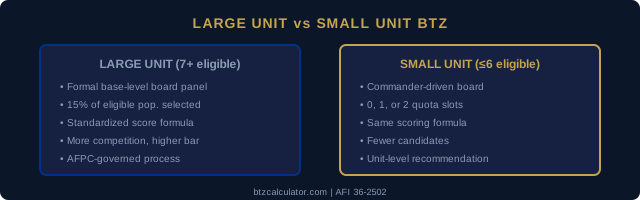
Two Airmen can have nearly identical BTZ packages and face completely different board experiences depending on how many eligible Airmen their unit has. One goes before a formal base-level panel with a standardized process and anonymous scoring. The other is evaluated by their own commander. The formula is the same. The competitive dynamics are not.
Understanding which type of board you're going to face, and how to prepare for each, is the kind of detail that separates informed BTZ candidates from those who show up hoping for the best.
How Unit Size Determines Board Type
Under AFI 36-2502, the determining factor is the number of Airmen who are promotion-eligible in the unit during a given BTZ cycle. The cutoff:
- ›7 or more eligible Airmen → Large Unit Board
- ›6 or fewer eligible Airmen → Small Unit Board
This count is per unit, per cycle. A squadron with 14 eligible Airmen in one cycle might have only 5 in the next. The board type isn't permanent. It's recalculated each time.
AFPC manages the BTZ cycle calendar. Your unit's Enlisted Promotions monitor coordinates with AFPC to determine eligibility counts and receive quota allocations.
The Large Unit Board: What Actually Happens
When a unit hits 7 or more eligible Airmen, the board convenes at the base level, not at the unit level. This is a formal panel typically composed of senior NCOs (E-7 and above) who often come from different squadrons than the candidates. They're evaluating Airmen they likely don't know.
The quota is fixed at 15% of eligible Airmen. Round half up. The math:
| Eligible Airmen | Quota (15%) | Selections |
|---|---|---|
| 7 | 1.05 → 1 | 1 |
| 10 | 1.5 → 2 | 2 |
| 14 | 2.1 → 2 | 2 |
| 20 | 3.0 → 3 | 3 |
| 27 | 4.05 → 4 | 4 |
The panel reviews each candidate's package, conducts an in-person interview, and scores them across the five board categories (0–10 each). The BTZ formula then combines board scores with the pre-board inputs, self-improvement, fitness, EPB, decorations, community involvement, and the top scorers get selected.
What makes the large unit board distinct:
The panel doesn't know you. They can't weight their judgment based on your reputation in the shop or how your supervisor talks about you. They see your uniform, they hear your answers, and they read your package. That's it.
This creates a genuinely meritocratic environment, the candidate who shows up sharpest and answers questions best has a real edge, even against peers who have better reputations in their home units.
It also means there's no benefit to familiarity. Your performance on the day of the board, combined with your documented scores, determines the outcome.
The Small Unit Board: Commander's Authority
When 6 or fewer Airmen are eligible, the process shifts to the unit commander. AFPC allocates quotas based on the small unit population:
| Eligible Airmen | Typical Quota Allocation |
|---|---|
| 1–2 | 0 or 1 |
| 3–4 | 1 |
| 5–6 | 1 or 2 |
The commander reviews packages and makes the selection recommendation. They may or may not convene a formal board, some commanders run a structured interview process, others make the decision based on documentation alone. AFI 36-2502 gives commanders discretion in how they evaluate small unit candidates.
What this means in practice:
Your commander almost certainly knows you in a small unit. They've seen your work, heard from your supervisors, and formed an opinion. This can work for or against you.
The same BTZ scoring formula applies, EPB multiplier, board scores (if a board is convened), fitness, decorations, community involvement. The math doesn't change because you're in a small unit. But if no formal board interview is conducted, the "board score" may be assessed differently or weighted through a commander's assessment process.
Ask your BTZ monitor and your supervisor directly: "What does the small unit evaluation process look like in our unit?" Different units handle this differently, and knowing the specific process shapes how you prepare.
Does the Scoring Formula Change? No. But the Competition Does.
The BTZ formula under AFI 36-2502 is the same regardless of board type. A Firewall 5 EPB is still ×1.25. An 8.0 board average is still 400 points. The base maximum is still 740, the overall maximum still 925.
What changes is the competitive pool. In a large unit board with 20 eligible Airmen and 3 slots, you're competing against 19 peers in a blind evaluation. In a small unit with 4 eligible Airmen and 1 slot, you're competing against 3 people whose packages and reputations your commander knows well.
In a large unit, a single outstanding board performance can overcome a weaker pre-board package. In a small unit, the board performance may matter less if the commander is relying primarily on documented record.
Neither type is inherently easier or harder, they're different environments with different dynamics.
How to Prepare Differently for Each
Large Unit Preparation Priorities:
Because the panel doesn't know you, your package and your board performance carry all the weight.
- ›Uniform: inspection-ready, not just regulation-compliant. Mirror-shine shoes, straight ribbons in precedence order, name tag alignment with a ruler.
- ›Job knowledge: practice out loud with people who don't know your job. If you can explain your AFSC's mission clearly to someone in a different career field, you can explain it to a board member from a different squadron.
- ›Communication: project confidence. Pause to think (3 seconds is fine), then answer directly. Don't qualify every statement.
- ›Package documentation: every decoration should be in your records, every volunteer hour logged, every education course reflected.
Small Unit Preparation Priorities:
Because your commander knows you, your daily performance over the past 6–12 months matters as much as the board day itself. But don't assume familiarity works in your favor, it can just as easily work against you if your record has any gaps.
- ›If a board interview is part of the process, prepare exactly as you would for a large unit board. Don't get casual.
- ›Ensure your EPB conversation happened early. In a small unit, there are fewer candidates for your supervisor to advocate for, your EPB rating is visible against a small comparison group.
- ›Verify your records are clean and complete. In a small pool, a missing decoration or unentered course is a larger relative gap.
- ›Have an honest conversation with your supervisor about where you stand relative to the other eligible Airmen in your unit.
A Worked Scenario: Same Package, Different Boards
A1C Torres has this profile:
- ›Board avg: 8.2 → 410 pts
- ›Self-improvement: 8 → 64 pts
- ›Fitness: (90/100) × 60 = 54 pts
- ›Decorations: 2 × 5 = 10 pts
- ›Community: 7 × 5 = 35 pts
- ›Base total: 573 pts
- ›Promote EPB: 573 pts → 61.9% → Moderate
Run that through the BTZ score tool and you'll see Torres is in the Moderate tier, not easily selected in a large unit where Highly Competitive candidates exist, but potentially competitive in a small unit if the pool is similarly scored.
In a large unit of 20 with 3 slots, Torres needs to outscoreAt least 17 peers. In a small unit of 4 with 1 slot, Torres needs to outscoreOnly 3, and if the commander's board is structured, a strong interview performance can move the needle.
The formula is the same. The math that determines selection is not.
One Consistent Factor Across Both Board Types
Regardless of large unit or small unit, the EPB multiplier determines more of your score than any other single variable. A Firewall 5 adds up to 185 points. No board performance or fitness score closes that gap alone.
For a full breakdown of the EPB's impact on your BTZ score, read how your EPB rating shapes your BTZ score. For benchmarks on what competitive scores actually look like across board types, see what makes a competitive BTZ score.
Before your board, large unit or small unit, run your current numbers through the BTZ promotion point calculator to see exactly where your package stands.
To learn more about the methodology behind this calculator and how scores are classified, visit the about page.
Related Tool
Calculate your Below the Zone promotion score
Written by
BTZ Calculator Team
Current and former Air Force NCOs with firsthand experience in the BTZ selection process, as candidates, supervisors, board members, and First Sergeants. All content is grounded in AFI 36-2502 and AFPC guidance. Learn more about us →