Military Bearing and Dress: Scoring at BTZ Boards
Military bearing and dress each account for up to 100 board points at BTZ. Learn what evaluators actually score and how to ace both categories.
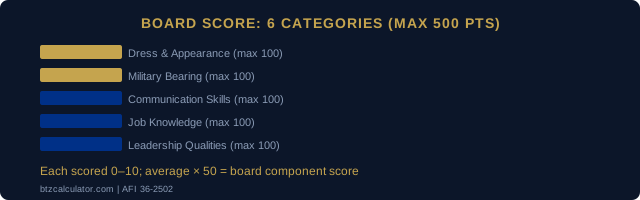
Military bearing and dress and appearance are two of the five categories scored during your BTZ board interview, and together they carry 200 of your 500 possible board points. That's 40% of your entire interview score sitting in categories that most Airmen treat as afterthoughts.
Your board score is calculated as the average of all five category scores (each rated 0–10), multiplied by 50. A single point drop across just these two categories costs you 10 points on your final board total. At a competitive board. That's the margin between getting selected and going home empty-handed.
What Military Bearing Actually Means
Military bearing is not just standing at parade rest with your chin up. That's the baseline, the absolute floor. Evaluators are looking for a composite of behaviors that signal you're already thinking and acting like a Senior Airman before you've earned the stripe.
The five things senior NCOs consistently look for:
Confidence without arrogance. You walk in like you belong there, not like you're hoping they'll let you stay. That means a firm knock, a clear "Airman [Last Name] reporting as ordered," and direct eye contact from the moment you cross the threshold.
How you enter and exit the room. This is where most Airmen lose points before they say a single word. Practice the sequence: knock twice, wait for acknowledgment, enter, close the door, walk to the reporting position, halt, face the board, and report. When dismissed, execute an about-face, open the door, and step out, don't shuffle sideways or glance back. The board is watching all of it.
Eye contact during answers. If there are three board members, distribute your eye contact across all of them as you answer, not just the person who asked the question. This signals situational awareness and confidence. Locking onto one person looks robotic; scanning the room aimlessly looks nervous.
Voice control. Speak loudly enough that the member at the far end of the table hears you clearly without you shouting. Trailing off at the end of sentences reads as uncertainty. Filler words ("um," "like," "you know") erode the impression fast.
Composure under pressure. Boards sometimes ask follow-up questions specifically to see if you can maintain bearing when challenged. "Are you sure about that?" is a test. Hold your answer or correct it calmly, don't start over or apologize excessively.
Use the BTZ score calculator to see exactly how much your board interview categories affect your total before you walk into that room.
Dress and Appearance: More Than Passing Inspection
Passing your unit's weekly uniform inspection is not the same as being board-ready. The standard for a promotion board is higher. Every senior NCO in that room has spent years wearing the uniform, and they notice things your supervisor may have stopped mentioning.
Common errors that cost real points:
- 1.Alignment. Name tape, US insignia, and rank should be measured, not eyeballed. The ABU/OCP nameplate sits 1/2 inch above the top button of the right breast pocket. If yours looks "about right," that's probably wrong.
- 1.Ribbons. Are they centered? In the right order of precedence? Is there a gap where an award was removed and never replaced? Ribbon racks on board day are scrutinized, bring a fresh rack if yours is faded or bent.
- 1.Boots. On OCP uniforms, boots should be clean and laced properly (straight-bar or ladder, consistently). Scuffed toes or loose eyelets catch eyes immediately.
- 1.Creases. Pressed ABUs/OCPs with sharp creases communicate attention to detail. If your uniform looks like it came straight from the dryer, spend the $5 at the cleaners the day before.
- 1.Hair. Men: tapered, within regulation at the ears and collar, no visible product buildup. Women: secured within the dimensions required by AFI 36-2903, no loose strands. Hair gets checked the moment you walk in.
- 1.Headgear. If you're wearing a combination cover or beret, it needs to sit correctly. Practice in front of a mirror, not just the day before.
The Pre-Board Uniform Checklist
Run through this 72 hours before your board, not the morning of:
- ›[ ] Uniform retrieved from cleaners or professionally pressed
- ›[ ] All patches, tapes, and insignia measured and re-affixed if needed
- ›[ ] Ribbon rack verified against your decoration records (use vMPF)
- ›[ ] Boot toes polished or cleaned, laces replaced if frayed
- ›[ ] Belt tip extends 2–4 inches past the buckle, tip aligned with zipper
- ›[ ] Name and US insignia measured to AFI 36-2903 spec
- ›[ ] Beret/cover fitted correctly, flash centered (if applicable)
- ›[ ] Hair cut within 7 days of board, in regulation
- ›[ ] Nails trimmed, no chipped polish (if applicable)
- ›[ ] Undershirt color matches regulation for your branch/uniform
Ask a trusted senior NCO, not a peer, to look you over 24 hours before the board. Fresh eyes catch things you've become blind to.
Practicing Military Bearing: A Drill That Works
Most Airmen practice their answers. Few practice their movement. Here's a drill that takes 15 minutes:
Set up a chair or desk as the "board table." Film yourself on your phone. Walk through the full sequence: knock, enter, report, sit (if directed), answer three questions, stand, about-face, exit. Watch the footage.
You will immediately notice things you didn't know you were doing, swaying, looking down when thinking, fidgeting with your hands, speaking too quietly. Fix one thing at a time. Run the drill again. After three sessions over three days, the sequence becomes muscle memory.
For additional context on how your board score fits into the overall picture, check out what makes a competitive BTZ score. And if you haven't read through how to prepare for your BTZ board, that's the starting point.
How Senior NCOs Score These Categories
Understanding the scoring scale helps you target where to improve:
- ›9–10: Exceptional. Immediately noticeable, this Airman looks and acts like they already have the stripe. Uncommon.
- ›7–8: Above average. Solid bearing, correct and sharp uniform, no errors that draw the eye. This is the target.
- ›5–6: Average. Meets the standard but nothing stands out. Won't hurt you badly, but won't help you win.
- ›3–4: Below average. Visible uniform discrepancies or bearing that reads as nervous or unprepared.
- ›1–2: Significant deficiencies. Uniform out of regs, poor composure, clearly not ready.
Most boards see a cluster of scores in the 6–7 range. If you can consistently earn 8s in bearing and dress, you've separated yourself from the field before the harder questions even start.
The Reality of "Passing Inspection" vs. "Board-Ready"
Your supervisor approves your uniform for formation. The board isn't formation. The mental shift you need is this: walk into that room dressed the way you would if the Chief of Staff of the Air Force walked in unannounced. Not paranoid, not overdone, just precise and clean.
The Airmen who earn 9s in dress and appearance didn't just wash their uniform. They measured every placement, got a fresh haircut two days prior (not the morning of, fresh cuts look harsh), and asked someone above the rank of E-6 to check them over.
For more detail on how the board scoring rolls up into your final BTZ number, visit the BTZ promotion score calculator and run your numbers. The about page explains the formula sources and how the scoring model was built.
Military bearing and dress are the two categories most within your control before you say a single word. Take them seriously and you walk in already ahead of half the room.
Related Tool
Calculate your Below the Zone promotion score
Written by
BTZ Calculator Team
Current and former Air Force NCOs with firsthand experience in the BTZ selection process, as candidates, supervisors, board members, and First Sergeants. All content is grounded in AFI 36-2502 and AFPC guidance. Learn more about us →