Community Involvement for BTZ: What Actually Counts
Community involvement adds up to 50 points to your BTZ score. Learn which activities qualify, how to document them, and how to go from a 3 to a 7 in 90 days.
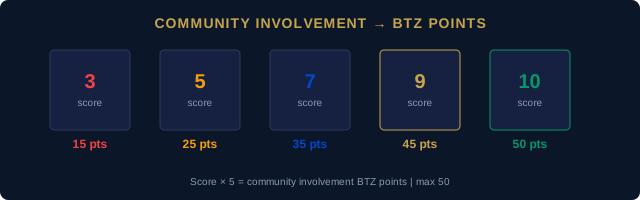
Community involvement is worth up to 50 points in the BTZ scoring formula, calculated as your score (0–10) multiplied by 5. A score of 10 gives you the full 50. A score of 3 gives you 15. That 35-point gap can be the difference between a competitive package and one that lands in the middle of the stack.
Most A1Cs underestimate this category because they confuse showing up with actually doing something. The board doesn't give you points for existing in your community. They give you points for documented, verifiable service.
What the Category Is Actually Measuring
Board evaluators reviewing your package aren't just counting hours. They're looking for evidence that you've chosen to give time and energy outside your duty requirements. The question they're implicitly asking: does this Airman take initiative and contribute beyond what's required?
The scoring reflects that intent. A 10 isn't reserved for Airmen who volunteered every weekend. It's for Airmen who led something, organized something, or made a measurable impact. A 7 or 8 can come from consistent, documented participation in 2–3 programs over 12 to 18 months.
Use the BTZ score calculator to see exactly how much your current community involvement score affects your overall total before you decide how much time to invest.
What Qualifies: Base Programs
Airman's Attic / Thrift Store. Volunteering to sort donations, staff the floor, or assist families is straightforward to document. Hours are logged, supervisors sign off, and the base program tracks records. This is one of the easiest starting points if you have zero community involvement on your record.
Key Spouse / Readiness programs. Helping organize family readiness events, participating in Key Spouse training, or assisting squadron family support activities counts, especially if you're in a unit where deployment cycles create real family support gaps.
Base chapel programs. Volunteering with chapel activities, youth programs, food drives, holiday assistance, qualifies. It doesn't matter what faith tradition, if any. The board is looking at service, not theology.
Youth sports and recreation. Coaching youth intramural teams, refereeing on-base sports leagues, or running youth fitness programs counts. If you're already playing, coach. It takes an extra 30 minutes per session and it builds your record.
AFA (Air Force Association) chapter activities. Local AFA chapters run scholarship programs, community events, and STEM outreach. Volunteering with your installation's chapter or a nearby civilian chapter qualifies. Many bases have a small AFA presence that's actively looking for junior Airmen to help.
Blood drives. Donating blood counts as participation. Organizing or staffing a blood drive on your base counts more. The American Red Cross and Armed Services Blood Program both run drives on most installations, ask your First Sergeant who coordinates them.
What Qualifies: Off-Base Programs
Off-base service counts and often scores better because it reflects broader initiative. You drove somewhere, connected with the civilian community, and contributed without being prompted by your unit.
Food banks and soup kitchens. Habitat for Humanity, local food pantries, Salvation Army holiday programs, all of these are verifiable, documentable, and viewed favorably. Many operate on a sign-in sheet system that gives you a volunteer record automatically.
Youth mentorship programs. Programs like Big Brothers Big Sisters, Boys & Girls Clubs, and school tutoring are high-value activities. They show sustained commitment (not just a one-time event), and the mentorship component aligns directly with the Air Force's emphasis on developing people.
Animal shelters. Less common for junior Airmen, but shelters keep volunteer logs and the board counts it. If you genuinely enjoy it. It's a low-barrier way to accumulate documented hours.
Local school outreach. JROTC assistance, science fair judging, career day presentations at local middle or high schools, all of these count and often make a strong impression because they show the Airman representing the Air Force positively in the civilian community.
What Does NOT Qualify
This is where Airmen lose points by misunderstanding the category.
Unit social events don't count. Going to the squadron BBQ, attending the holiday party, or participating in unit PT, none of this is community service. It's participation in your unit's activities, which is expected of everyone.
Being a generally "good person" doesn't count. Helping a coworker move, giving someone a ride to the airport, being friendly, the board needs documented, verifiable service in recognized programs.
Unit-directed volunteer events with mandatory attendance don't carry full weight. If your entire unit was required to show up to the base cleanup day, the board knows that was a directed tasker. It might be counted minimally, but it won't score the same as something you chose to do on your own time.
Donations without time. Donating money to a charity or dropping items at Toys for Tots counts for less than actually working the event. Time-based service is what the category is measuring.
How to Document Involvement for Your Board Package
Documentation is where most Airmen fail. They do the work and don't capture it.
Every time you volunteer, you need three things:
- 1.The name of the organization and program
- 2.The date(s) and hours served
- 3.A point of contact (name and phone/email) who can verify it
Keep a running document, a notes app, a spreadsheet, a Google Doc, with this information logged after every event. When your package is being built, your supervisor needs to turn this into bullet points. If you don't hand them the raw data, they're guessing, and guessing produces weak bullets.
The difference between a strong community involvement bullet and a weak one:
- ›Weak: "Volunteered with local food bank"
- ›Strong: "Donated 14 hrs to Second Harvest Food Bank; directly supported 200+ food-insecure families in surrounding county, Jan–Mar 2026"
Specifics matter. Hours, numbers served, outcomes. That's what moves a board evaluator.
Going from a 3 to a 7 in 90 Days
A score of 3 means you have minimal documented involvement, maybe one event with no consistent record. A 7 means consistent, documented, multi-program involvement that reflects genuine initiative. Here's a realistic 90-day path:
Days 1–7: Identify 3 programs you can realistically commit to. One on-base (Airman's Attic or chapel), one off-base (food bank or youth program), one semi-regular (AFA chapter or blood drives). Sign up. Get confirmation emails or program contacts.
Days 8–30: Complete your first session at each program. Log the hours immediately, don't wait. Email yourself the details so you have a date-stamped record.
Days 31–60: Attend at least 2 more sessions total. If you find one program you genuinely like, go more. Consistency over the same program looks better than scattered single visits to 10 different places.
Days 61–90: Tally your hours. Write out the documentation in the format above. Have your supervisor review the draft bullets. If you have a leadership role, organized an event, led a team, mentored someone, make sure that's captured specifically.
Forty to 60 hours of documented service across 2–3 programs over 90 days is enough to support a score of 6–7. Add a leadership component and you're looking at a 7–8.
How This Fits Into Your Total Score
A community involvement score of 4 gives you 20 points. A score of 8 gives you 40. That 20-point improvement might not sound like a lot in isolation, but when you're competing against other Airmen at a large unit board, where selections might be as narrow as the top 15% of eligible E-3s, 20 points is substantial.
For context: a full 60-point fitness score (FA score of 100) versus a 45-point fitness score (FA score of 75) is a 15-point gap. You can close a bigger gap with community involvement than with pushing your fitness score from 90 to 100. That's worth remembering when you're prioritizing prep time.
Run your current numbers through the BTZ promotion points estimator to see exactly where community involvement sits in your total score breakdown.
For more on how the full scoring system works and which categories deserve the most attention, read what makes a competitive BTZ score. If decorations are an area you haven't addressed yet, decorations and awards that boost your BTZ score covers that category in detail.
The about page explains how the scoring model was developed and the AFI 36-2502 sources behind each formula component.
One Thing Most NCOICs Will Tell You
The Airmen who come in with a 9 or 10 in community involvement almost always have one thing in common: they started before they knew a board was coming. Service that looks authentic to a board actually is authentic, because it started before the pressure of a promotion cycle.
If you're 90 days out and building from scratch, you can still make a strong showing. But if you're reading this 18 months before your expected board window, start now. Do something you'd actually want to do, document it properly, and let the record build naturally.
That's what a 9 looks like.
Related Tool
Calculate your Below the Zone promotion score
Written by
BTZ Calculator Team
Current and former Air Force NCOs with firsthand experience in the BTZ selection process, as candidates, supervisors, board members, and First Sergeants. All content is grounded in AFI 36-2502 and AFPC guidance. Learn more about us →