10 BTZ Board Mistakes Airmen Make (And How to Avoid Them)
Ten real BTZ board mistakes that cost Airmen points, from uniform errors to EPB math they never ran, and exactly how to avoid each one.
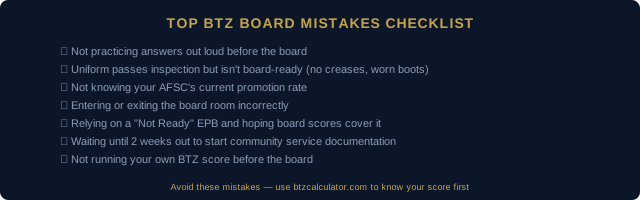
Every BTZ board has Airmen who were qualified on paper and still didn't get selected. Not because they lacked potential, but because they made avoidable mistakes that eroded their score or left points on the table. These are the 10 most common ones, based on patterns that senior NCOs see repeatedly across large unit and small unit boards.
Before your board date, run your current numbers through the BTZ promotion calculator so you know exactly where you stand and which categories need the most attention.
Mistake 1: Not Practicing Answers Out Loud
Reading through potential questions in your head is not preparation. It's familiarity. There's a significant difference between knowing what you'd say and actually saying it under pressure with three senior NCOs watching you.
Airmen who practice silently often freeze or stumble when a board member stares at them and waits. The silence feels longer than it is, and panic sets in.
The fix: record yourself on your phone. Speak every answer aloud as if you're in the room. Watch the footage. You will hear filler words, catch trailing-off sentences, and notice that answers you thought were clear are actually vague. Do this 10–15 times across different questions over the two weeks before your board. By the time you sit down, the muscle memory for speaking clearly under pressure is there.
Mistake 2: Wearing a Uniform That Passes Inspection But Isn't Board-Ready
There's a gap between "passes your flight chief's inspection" and "board-ready." Inspections at the unit level check that you're within regulation. A board scrutinizes whether you look like someone who deserves a promotion.
Common gaps: ribbons in the wrong precedence order, measurement of insignia that's "close enough," boots that are clean but scuffed at the toes, a uniform that's regulation but clearly hasn't seen a hanger or a press.
The fix: 72 hours before your board, lay out your full uniform and go through every measurement against AFI 36-2903. Get a trusted E-6 or above to inspect you, not a peer, someone with real experience. Address every discrepancy. The goal isn't passing; it's looking like you're already a SrA.
Mistake 3: Not Knowing Their AFSC's Current Promotion Rate
Board members ask this. "What's the current SrA promotion rate for your AFSC?" If you don't know the answer, or worse, if you've never looked it up. That's a visible gap in job knowledge and self-awareness.
This question tests whether you've actually engaged with the system you're competing in, or whether you're just showing up and hoping for the best.
The fix: check the AFPC website (mypers.af.mil) before your board for your AFSC's current BTZ and regular SrA selection rates. Know the current Air Force-wide BTZ rate (approximately 15% of the eligible population in any given cycle). Know how your AFSC compares. Being able to speak intelligently about the competitive landscape in your career field shows maturity and situational awareness.
Mistake 4: Entering and Exiting the Room Incorrectly
The board is evaluating you from the moment you knock. Most Airmen practice the content of their answers and don't practice the mechanics of entering and leaving the room, and it shows.
Common errors: knocking without waiting for a response before entering, closing the door while still facing the room, shuffling sideways instead of a clean about-face, failing to report properly upon entering. On the way out: forgetting the about-face, thanking the board (don't, just report and exit), glancing back over the shoulder.
The fix: physically practice the full sequence. Set up a doorway. Knock twice, wait, enter, close the door, walk to the position, halt, face, report. When dismissed, about-face, walk to the door, open it, step out, close it. Do this 20 times until it's automatic. Film it if possible. The sequence should be fluid and confident, not performed.
Mistake 5: Giving Rehearsed-Sounding Answers That Don't Feel Authentic
There's a version of over-preparation that backfires. Airmen who memorize answers word-for-word often come across as robotic, they're reciting, not communicating. Board members notice when an answer sounds like it was lifted from a script.
The tell: when a board member asks a follow-up or slightly rephrases a question, the scripted Airman stumbles because the exact answer they memorized doesn't fit anymore.
The fix: prepare frameworks, not scripts. Know the key points you want to make for each question category. Practice delivering them conversationally, not verbatim. Allow some natural variation. The goal is a confident, structured answer that sounds like a person talking, because it is.
Mistake 6: Underestimating the EPB Multiplier Impact
This is a math problem that too many Airmen don't run until it's too late.
The EPB multiplier applies to your entire base score (board points + self-improvement + fitness + decorations + community involvement). A Firewall 5 EPB multiplies your base total by 1.25. A "Promote" multiplies by 1.0. The difference between those two isn't just "a little better", on a base score of 600 points, the Firewall 5 earns you 750 points; the Promote gives you 600. That's 150 points from a single multiplier.
The fix: have the direct conversation with your supervisor at least 4 months before your expected board date. Ask specifically what they'd need to see to write a Firewall 5 EPB. Get concrete criteria. Then work toward them visibly and documentably. Don't assume you know what they're looking for, ask.
Mistake 7: Not Having Decorations Submitted Before the Board Meets
A decoration your supervisor meant to submit but didn't is worth exactly zero points on your BTZ score. Intent doesn't count. Approved, recorded decorations count.
The typical AFAM submission takes 45 to 90 days from initiation to appearing in your official records. Airmen who start that conversation the week before their board lose any chance of the decoration contributing to their score.
The fix: 90 days before your board, have the conversation with your supervisor about whether a decoration submission is warranted. If yes, make it easy for them, provide a bulleted list of accomplishments with specific dates and outcomes. Follow up at 60 days to verify the submission is in the pipeline. At 30 days, confirm it's been processed and check your vMPF records. A decoration not on record is a decoration that doesn't exist for BTZ purposes.
Mistake 8: Ignoring Community Involvement Until the Last 2 Weeks
The community involvement category (max 50 points, score × 5) requires documented, verifiable service in recognized programs. You cannot accumulate a credible record in 14 days.
What the last 2 weeks before a board actually looks like: Airmen show up to one Airman's Attic session, try to get a supervisor signature, and hope that single afternoon of sorting donations moves their score. It doesn't. Boards have seen this pattern enough that a thin, last-minute volunteer record is recognized for what it is.
The fix: start community involvement 90 to 180 days before your board. Commit to 2–3 programs. Log dates, hours, and contacts after every session. A score of 7 or 8 (35–40 points) requires consistent, documented service across multiple programs over several months, not a sprint at the end. The Airmen who score 9s genuinely started before they knew a board was coming.
Mistake 9: Focusing Only on Board Prep and Neglecting Fitness
Board prep is visible and immediate, there are questions to practice, a uniform to iron, facts to memorize. Fitness improvement is slow and unglamorous, so it often gets deprioritized during the 6-week sprint before a board.
This is a mistake with a measurable cost. The fitness category contributes up to 60 points (FA score ÷ 100 × 60). An Airman scoring 75 on the FA earns 45 points. An Airman scoring 90 earns 54 points. That 9-point gap from fitness alone is as large as a 2-point improvement in self-improvement score (which adds only 16 points).
The fix: don't wait until 6 weeks out to address fitness. Training adaptations take 8 to 12 weeks to show in test results. Start your fitness plan at the 90-day mark at the latest. If your FA is coming up in the 60-day window before your board, treat it seriously. It's a scoring event, not just a pass/fail requirement.
Mistake 10: Not Running Their Numbers Before the Board
The most common mistake isn't dramatic. It's this: Airmen walk into the board not knowing whether their package is competitive, what their approximate score is, or which category is dragging them down.
When you don't know your numbers, you can't prioritize. You spend equal time on everything, or you focus on what feels important rather than what has the highest point impact. You also can't have an intelligent conversation with your supervisor about where to focus your development.
The fix: calculate your approximate BTZ score at least 90 days before your board. Use the BTZ score breakdown tool to see your points by category. Then look at each category and ask: where can I realistically add 10 to 20 points in the time I have? That answer should drive your entire prep strategy.
For a deeper look at what separates competitive packages from average ones, read what makes a competitive BTZ score. And for a full timeline on how to build your package from the ground up, how to prepare for your BTZ board covers each phase in detail.
The about page explains the formula used in the calculator and the AFI 36-2502 sources it's built on.
The Common Thread
Most of these mistakes share the same root cause: starting too late and not treating the board as a scored competition with a specific formula.
BTZ isn't a vibe check. It's a calculated score against a defined rubric, applied to a pool of eligible Airmen. The ones who get selected understand the formula, know their numbers, and spend their prep time where it actually moves the score.
Start earlier than you think you need to. Run the numbers. Fix what's fixable. And practice out loud.
Related Tool
Calculate your Below the Zone promotion score
Written by
BTZ Calculator Team
Current and former Air Force NCOs with firsthand experience in the BTZ selection process, as candidates, supervisors, board members, and First Sergeants. All content is grounded in AFI 36-2502 and AFPC guidance. Learn more about us →