AF Fitness Test Scores and BTZ: How Fitness Points Work
Your Air Force Fitness Assessment score converts directly into BTZ points. A 75 earns 45 pts, a 90 earns 54 pts, here's what that gap means and how to close it.
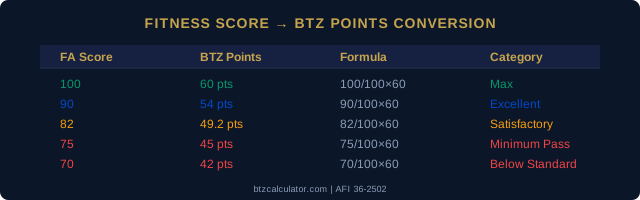
Your Air Force Fitness Assessment (FA) score feeds directly into your BTZ total through a straightforward formula: FA score divided by 100, multiplied by 60. The maximum is 60 points, earned with a perfect 100 on your FA. A score of 75 gives you 45 points. A score of 90 gives you 54 points.
That 15-point gap between a 75 and a 90 is real and significant. In a competitive BTZ window where selections might come down to 10 to 20 points across a group of qualified Airmen, closing that gap through dedicated fitness training is one of the most controllable improvements available to you.
The Conversion Formula Explained
The math is clean: take your composite FA score, divide by 100, multiply by 60.
| FA Score | BTZ Fitness Points |
|---|---|
| 60 | 36.0 |
| 65 | 39.0 |
| 70 | 42.0 |
| 75 | 45.0 |
| 80 | 48.0 |
| 85 | 51.0 |
| 90 | 54.0 |
| 95 | 57.0 |
| 100 | 60.0 |
Every 5-point improvement in your FA score adds 3 points to your BTZ total. That might sound small, until you realize the entire community involvement category maxes out at 50 points, and the difference between an average and above-average volunteer record is often 15–20 points. A 15-point fitness improvement gets you to the same place, and your FA score is largely within your own control.
Pull up the BTZ score estimator and adjust your fitness score up by 10 points. Watch what happens to your total. That's a concrete, achievable target to set.
Why the Run Component Usually Decides Your Score
The Air Force FA has four components: aerobic (1.5-mile run or alternative cardio), push-ups, sit-ups, and waist circumference. The aerobic component carries the most scoring weight, 60 points of the 100 possible. Push-ups and sit-ups each contribute 20 points. Waist circumference can eliminate you entirely if you exceed the standard, but doesn't add points.
Most Airmen who score in the 75–80 range are losing their points on the run. They can knock out solid push-up and sit-up numbers but can't sustain the pace on the 1.5-mile. This is where 90 days of deliberate work pays off the most.
If your run is pulling you down. Here's the direct calculation impact:
- ›Running a 12:00 1.5-mile for most age/gender categories scores around 55–60 points on the aerobic component, meaning 33–36 out of a potential 60 for the full FA.
- ›Running a 10:30 typically scores around 75–80 on the aerobic component, netting 45–48 of 60.
- ›Running a 9:30 or under typically scores 95+ on the aerobic component, netting 57+ of 60.
That range in aerobic component alone can swing your composite FA score by 15 to 20 points, which directly translates into 9 to 12 additional BTZ points.
What a 90-Day Fitness Improvement Plan Looks Like
Ninety days is enough time to meaningfully improve your FA score if you train deliberately. The key word is deliberately, not just showing up to unit PT and hoping for the best.
Weeks 1–4: Build the aerobic base
Run 4 days per week. Two of those days should be easy-paced runs of 20–30 minutes (conversational pace, you can speak in sentences). One day should be a tempo run, 15–20 minutes at a comfortably hard pace where speaking is difficult. One day should be intervals: 6–8 repetitions of 400 meters at a hard effort with 90-second recovery walks between each.
Don't race your FA pace every run. Easy runs build the aerobic engine. Hard runs build speed. You need both.
Weeks 5–8: Add volume and sharpen the intervals
Increase your easy run days to 30–40 minutes. Drop the interval distance to 200 meters but increase reps to 10–12, running each one at a sprint effort with 60-second recovery. Add one longer run per week, 35–45 minutes at easy pace, to build endurance that carries over to the 1.5-mile.
Start doing push-ups and sit-ups in structured sets 3 days per week if you're not already. Aim for 5 sets to near-failure, with 90-second rest between sets.
Weeks 9–12: Race-specific prep and test simulation
Two to three weeks before your scheduled FA, run a time trial at full effort on the same type of track or surface where you'll test. This tells you exactly where you are and what adjustment is needed.
Continue interval work but reduce volume, you're sharpening, not building. Your last hard workout should be 5 days before the FA, not the day before.
The Waist Measurement: Don't Let This Neutralize Your Prep
The waist circumference component doesn't add points, but it can make you ineligible to test or result in an automatic failure if you exceed the standard. For most male Airmen the limit is 39 inches; for female Airmen it's 35.5 inches (verify current standards in AFI 36-2905, as these are periodically updated).
If you're close to the limit, address this first. A body composition that skirts the waist standard doesn't just risk the FA, it signals to the board that you may not fully meet fitness standards, which can affect military bearing and appearance scores too.
Waist measurement improves through the same work that improves your run time, cardiovascular training and caloric discipline. These aren't separate problems.
Addressing Your Weakest FA Component
If you already run a 9:45 and your composite is still sitting at 78, your weakness is in push-ups or sit-ups. Here's a quick diagnostic:
Push-up score below 70% of component maximum: Add push-up-specific training 4 days per week. Use the "grease the groove" method, do sets throughout the day that are not to failure, just frequent. 5 sets of 15 reps spread across the workday adds up fast without destroying your recovery.
Sit-up score below 70%: Structured core work 4 days per week. Decline sit-ups, hanging leg raises, and planks all build the hip flexor and abdominal strength the FA sit-up tests. Don't just do FA-style sit-ups, build the underlying strength first.
Both push-ups and sit-ups are weak: Focus on them 3 days each per week with a rest day between. Your run training doesn't need to change if it's already strong.
Timing Your FA Before the Board
If your most recent FA is 6 or more months old and you've been training hard, try to schedule a new test before your board package is locked in. A higher, more recent score shows the board you're maintaining and improving your fitness, not just coasting on a score from a year ago.
Check with your unit fitness program manager about the scheduling window. Most installations offer test appointments on a rolling basis. If you're in a BTZ-eligible window, your chain of command should support getting you a test date.
Don't schedule your FA less than 2 weeks before the board date. You want the score processed and visible in your records with time to verify it's been entered correctly.
Putting It Together: A Real Score Scenario
A1C Martinez is preparing for a BTZ board in 10 weeks. Current FA score: 78 (earning 46.8 BTZ fitness points). After 8 weeks of interval training and structured push-up work, she retests at 88 (earning 52.8 BTZ fitness points). That's a 6-point improvement in BTZ score from fitness alone, without touching any other category.
Now add a decoration she worked with her supervisor to submit (5 points), and an additional 2 hours per week of documented community involvement that moves her score from a 5 to a 7 (10 additional points). Those three targeted improvements add 21 points to her total before the EPB multiplier is applied.
See where your own numbers land with the BTZ promotion calculator and identify which category gives you the best return for your available prep time.
For more on how the overall BTZ scoring works and which factors carry the most weight, read what makes a competitive BTZ score. And if you're mapping out a full board prep timeline, how to prepare for your BTZ board covers the full picture from six months out.
The about page explains the formula sources and how the fitness conversion was derived from AFI 36-2502.
One Thing That's Easy to Miss
Your FA score for BTZ purposes is typically the most recent score in your official records at the time the package is evaluated. Make sure your score is entered correctly. Check your fitness records in the Air Force fitness portal or with your unit fitness program manager. Errors in fitness record entry are not rare, and a missing or incorrect score can cost you points before the board ever sees your package.
Verify it. Then train to improve it. In that order.
Related Tool
Calculate your Below the Zone promotion score
Written by
BTZ Calculator Team
Current and former Air Force NCOs with firsthand experience in the BTZ selection process, as candidates, supervisors, board members, and First Sergeants. All content is grounded in AFI 36-2502 and AFPC guidance. Learn more about us →